
If you were to ask someone, “What is Gresham’s Law?”, their answer, if they give one at all, will probably be “Bad money drives out good money.” This is not Gresham’s Law.
Gresham’s Law holds that when two or more currencies are held by law to be equal when they are not, then people will purchase the undervalued currency with the overvalued currency, and they will hoard the undervalued and spend the overvalued. This leads the undervalued to disappear from circulation, and the overvalued to dominate.
The familiar version of Gresham’s Law implies that people use bad currency for the sake of it being a bad currency, as if people were irrational, but people are rational. The real Gresham’s Law gives a rationale for why bad currencies sometimes dominate. Bad money dominates because of government-determined rates of exchange that depart from the market rate of exchange. If you remove the government-determined exchange rates, the familiar version of Gresham’s Law—that the bad drives out the good—no longer holds. There simply would be no incentive to hoard the undervalued money.
An implication of this is that the fiat dollar in the US is not the bad money in Gresham’s Law. It may be bad for many reasons—not backed by a commodity, controlled by a central authority, monopolized—but it is not necessarily bad in the Gresham’s Law sense. It would be bad in the Gresham’s Law sense if the government determined exchange rates between the USD and other fiat monies. The value of monetary metals such as gold and silver freely fluctuates against the USD.
Where does Gresham’s Law matter?
It matters in foreign exchange markets where the US government and foreign powers seek to establish exchange rates between currencies.
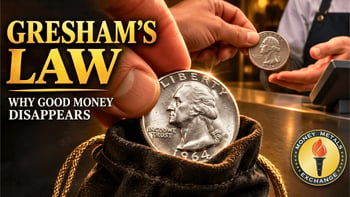
Gresham’s Law also helps explain why we do not find silver quarters or dollars anymore. For example, a silver quarter has an equal face value to modern quarters, which have zero silver content. The government has effectively established an exchange rate between silver quarters and the material in modern quarters. The silver quarter is undervalued in this case. People hoard the silver quarters by buying them with modern quarters, and the silver quarters disappear from circulation. This might theoretically happen with copper pennies as well, but the cost of searching for copper pennies likely outweighs the minuscule benefit of acquiring the copper.
What other common errors do people make about Gresham’s Law? Some economists make Gresham’s Law about asymmetric information. Asymmetric information occurs when one party of an exchange knows more than the other person. Economist George Akerlof used Gresham’s Law as an analogy for his famous market for lemons.
In the market for lemons paper, Akerlof runs through a hypothetical where bad cars (lemons) drive down the average quality of cars, and when there is asymmetric information, the bad cars drive down the price, and the owners of good cars take their cars off the market. As a result, the average quality of cars falls, and the process repeats until there are only lemons on the market. In this case, bad cars drove out the good because of imperfect information. Akerlof recognizes that this is not actually Gresham’s Law because, as he notes, the “buyer and seller can tell the difference between good and bad money.” Despite Akerlof making this caveat, other economists have referred to Akerlof’s paper as “the generalization of Gresham’s law” (emphasis mine).
Why is this important?
It is important because ignorance does not lead bad money to drive out good money. Holders of money are being completely rational. In Gresham’s Law, they are responding to government policy. It may be the case that if the quality of money is unknown, and if so, then lower-quality money dominates precisely because of Akerlof’s point, but this is different from Gresham’s Law.
The two misconceptions covered above, that (1) bad money (unconditionally) drives out good and that (2) Gresham’s Law is an ignorance problem, contribute to broader misconceptions about consumer behavior in the market. It contributes to the misconception that consumers are irrational or ignorant, especially in the market for money, and require government assistance. Combating these two misconceptions is necessary for avoiding this greater error of government meddling in the market for money.
If we do not want “bad money to drive out good,” then we must avoid any and all regulations that impose a rate of exchange on monies/currencies. Consumers are perfectly capable of selecting good money. Without government exchange rates, they have less of an incentive to select the bad.
How can we escape the regime of bad money we are currently in?
Without government meddling in general, fiat money will be abandoned for money that has some backing of gold and silver. We must eliminate laws that establish a monetary monopoly. Under a metal-backed currency, we must be further vigilant against attempts to devalue this currency through debasement.
Originally Published on Money Metals.


