
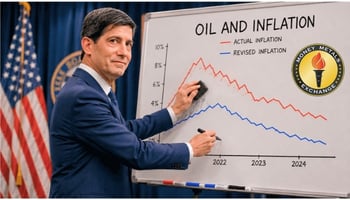
Oil prices have risen sharply in recent months after a period of relative calm, pushing gasoline prices higher across the United States. The U.S. Energy Information Administration reports that Brent crude oil averaged $103 per barrel in March of 2026 and continues to remain high as the Iran War continues. At the retail level, the AAA reported a national average gasoline price of about $4.03 per gallon in late April.
The timing of this is awkward for policymakers. After peaking at 9.1 percent in June 2022, consumer price inflation slowed substantially. Recent data, however, complicate the narrative of a clean return to stability. The U.S. Bureau of Labor Statistics reports that consumer prices rose 0.9 percent in March and 3.3 percent over the last year, with core inflation still running above target.
Many argue, nevertheless, that the Federal Reserve has largely succeeded in bringing inflation under control and that the economy is approaching a “soft landing.”
But rising energy prices are challenging that narrative.
Price inflation often appears stable while favorable conditions temporarily hide the distortions created by years of easy money — until a shock, like rising energy costs, reveals how little control policymakers truly have.
Energy shocks are seldom confined to the pump. With energy sitting near the beginning of many production processes, rising fuel costs affect transportation, agriculture, manufacturing, and logistics throughout the entire economy. Trucking firms face higher diesel expenses, airlines operate on thinner margins, farmers pay more to run their equipment, and manufacturers are faced with more expensive shipping and production inputs.
Now, these higher costs do not mechanically translate into higher prices. Firms can only charge higher prices if consumers are willing and able to pay them. Instead, rising energy costs often force businesses to reevaluate production plans, reduce output, postpone investment, absorb losses, or simply exit less profitable lines of production altogether. As marginal producers scale back or leave the market entirely, the supply of goods contracts, placing upward pressure on prices over time. What begins as an energy shock therefore causes broader disruptions in the structure of production across time.
Federal Reserve governor Christopher Waller suggested that he does not expect the current oil shock to have a persistent impact on inflation. At the same time, however, he warned that if elevated energy prices persist, they could begin to bleed “through to other parts of the economy.”
In this uncertainty, we see a core limitation of monetary policy. Central banks, yes, can influence credit conditions through open market operations, but they cannot produce oil, reopen disrupted trade routes, or resolve geopolitical crises. When price inflation occurs because of real supply constraints, monetary policy offers no clear path forward.
If the Federal Reserve tightens policy in response, higher borrowing costs could discourage investment, weaken hiring, and place additional stress on interest-sensitive sectors like housing and construction. But loosening policy would create its own problems by accelerating monetary expansion and further distorting investment decisions throughout the economy.
This dilemma reflects a deeper issue: price inflation does not arise from a single source that can be controlled with precision. It emerges from an interaction of monetary conditions, the production structure, and real-world supply levels.
Economists in the Austrian tradition have long emphasized that prices coordinate production across time. Interest rates and relative prices guide entrepreneurs as they decide how much to invest, which production processes to choose, and how resources move throughout the economy.
Prolonged periods of easy money distort these signals. Artificially low interest rates encourage firms to undertake longer and more complex projects that appear sustainable under stable conditions. When financing is cheap, businesses expand capacity, extend supply chains, and commit resources to projects dependent upon costs remaining predictable.
When real shocks occur — like a sudden rise in energy prices — those presumptions break down. Higher input costs shrink margins, production gets disrupted, and firms revisit their earlier decisions as viability quickly disappears for projects.
Adjustments are rarely smooth and even. In the aggregate, it might even be harder to detect underlying production strains that are intensifying. This helps explain why price inflation can appear to recede (temporarily) then reemerge when a new shock hits an already fragile production structure.
Both stability and instability rarely persist. Energy markets remain volatile, geopolitical risks continue to threaten global trade, and supply chains remain vulnerable to disruptions. When these shocks occur, they interact with an economic structure already shaped by years of earlier poor monetary and investment decisions, which then often leads to further supply contractions and price pressures.
None of this suggests that monetary policy is irrelevant. Interest rates and credit conditions clearly influence borrowing, investment, and financial markets. But the belief that central bankers can accurately and precisely manage inflation overlooks the complexity of the production process. Price inflation does not simply disappear because central banks want to declare victory. It merely waits for the next shock to remind us how little control policymakers actually have over the forces shaping prices.
Originally Published on Money Metals.

Antón Chamberlin holds a PhD in economics from Middle Tennessee State University, as well as Bachelor's and Master's degrees from Loyola University New Orleans and Troy University. He is currently pursuing an MA in Theology at the University of Notre Dame.

